Bitcoin Custody
With Galoy, you can choose your own custodian: BitGo, Anchorage, Coinbase Prime, Fireblocks, Fidelity, or any other qualified provider. Plug in one, plug in several, or custody in-house.
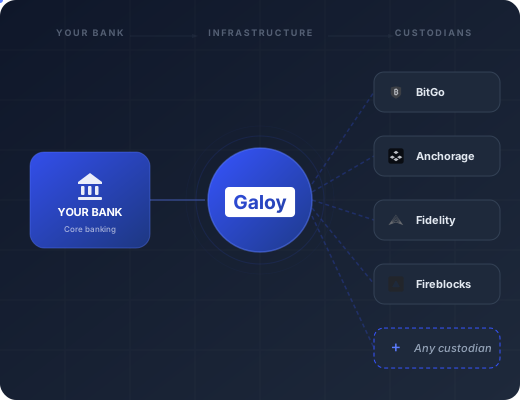
With Galoy, you can choose your own custodian: BitGo, Anchorage, Coinbase Prime, Fireblocks, Fidelity, or any other qualified provider. Plug in one, plug in several, or custody in-house.
The OCC has issued interpretive letters confirming banks can custody digital assets. The custody landscape is expanding fast, and banks need infrastructure that doesn't lock them into a single provider.
Connect to one or more qualified custodians through a single integration. Designed to support multi-signature key management and seamless coordination across providers.
For banks that operate their own qualified custody, Galoy's infrastructure integrates with the bank's enterprise key management and segregated client accounts. Galoy is the orchestration layer; the bank holds the keys.
Designed to support distributing holdings across multiple custodians to reduce concentration risk and meet internal risk management policies.
Full transaction history with on-chain and off-chain audit trails. Designed for SOC 2, OCC, and state regulator examination requirements.
Our stack is designed to let your bank plug in the custodian that fits. We integrate with the providers your compliance team already knows, and the ones they're evaluating next.
 BNY Mellon
 Fidelity Digital Assets
 State Street
 BitGo
BitGo
 Coinbase Prime
 Anchorage Digital
 Fireblocks
 NYDIG
BNY Mellon
Fidelity Digital Assets
State Street
BitGo
Coinbase Prime
Anchorage Digital
Fireblocks
NYDIG
NYDIG
BNY Mellon
Fidelity Digital Assets
State Street
BitGo
Coinbase Prime
Anchorage Digital
Fireblocks
NYDIG
Your bank picks the custodian. We handle the integration. These providers represent the current landscape, not endorsements or exclusive partnerships.
We deploy as a sidecar alongside your existing banking core, whether you run Jack Henry, FIS, Fiserv, or another platform. No core replacement required.
Custody position data, transaction records, and audit trails flow back to your general ledger through your core's existing integration pathways, keeping your reporting and compliance workflows intact.
Common questions from bank executives, risk officers, and technology teams evaluating Galoy's custody orchestration.
No, Galoy is custody-independent. The bank selects its own qualified custodian (BitGo, Anchorage, Coinbase Prime, Fireblocks, Fidelity, etc.) or operates its own in-house custody, and Galoy's infrastructure coordinates with whichever custody arrangement the bank chooses.
Galoy is designed to integrate with any qualified custodian a bank chooses. Production integrations include the major institutional custodians used by US banks today, and the integration model is custody-agnostic so adding a new custodian doesn't require core changes.
Yes. Banks can route different customer segments, asset classes, or risk tiers to different custodians. Galoy's ledger reconciles balances across custody venues so the bank's books stay consistent regardless of where assets live.
Custody migration is a configuration change in Galoy, not a re-platforming exercise. Because the custody integration sits behind a standard interface, swapping or adding a custodian doesn't require changes to the bank's core systems or to customer-facing apps.
Every custody interaction is recorded as an immutable event in our double-entry ledger, with full reconciliation against the custodian's records. Auditors can trace any balance back to the originating custody event. The orchestration layer enforces segregation of client accounts and supports the bank's existing audit and regulatory reporting workflows.
See how Galoy gives your bank custodian-agnostic infrastructure for Bitcoin and digital assets.