Stablecoin Payments
Enable stablecoin payment rails alongside traditional banking. Bridge traditional finance and digital rails with infrastructure designed for GENIUS Act compliance.
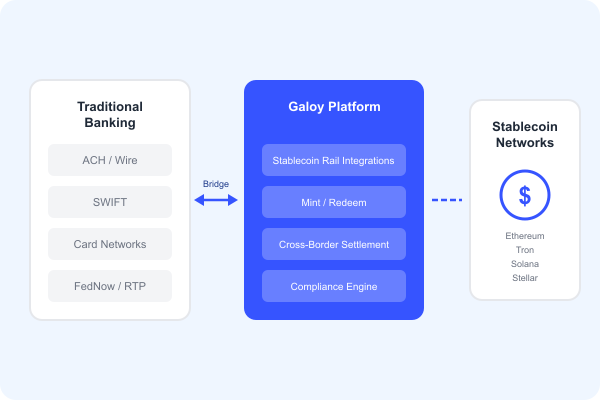
Enable stablecoin payment rails alongside traditional banking. Bridge traditional finance and digital rails with infrastructure designed for GENIUS Act compliance.
Stablecoins bridge traditional finance and digital rails, enabling faster, more accessible payment networks. We enable institutions to operate stablecoin payment infrastructure alongside traditional banking networks.
Near-instant stablecoin transfers versus days for traditional wire transfers.
Cross-border stablecoin payments without correspondent banking friction.
Designed for GENIUS Act compliance and regulated stablecoin frameworks.
Stablecoin infrastructure designed for regulated financial institutions
Support for USDC and tokenized deposit settlement. Multi-currency infrastructure that bridges fiat and digital rails.
Stablecoin transfers settle in minutes, not the days required by traditional wire and ACH rails.
Send stablecoin payments globally without correspondent banking friction or multi-day settlement delays.
Designed for compliance with the GENIUS Act framework and evolving state and federal stablecoin regulations.
Seamless conversion between fiat and stablecoin rails through your existing banking infrastructure.
Full transaction history with compliance hooks, monitoring, and reporting integration for regulatory examinations.
Customer initiates a stablecoin payment or transfer through your institution's banking interface.
Fiat is converted to stablecoin through your institution's on-ramp process, or stablecoin is sent directly.
Stablecoin settles on-chain in minutes. Recipient can hold as stablecoin or convert to local fiat.
Transaction data flows to your GL and compliance systems. Full audit trail maintained automatically.
We deploy as a sidecar alongside your existing banking core, whether you run Jack Henry, FIS, Fiserv, or another platform. No core replacement required.
Stablecoin payment data flows back to your general ledger through your core's existing integration pathways, keeping your reporting and compliance workflows intact.
Common questions about stablecoin payments for institutions
Galoy supports USDC for institutional payments and is built to add additional regulated, fully reserved dollar stablecoins as they qualify under federal and state frameworks. The platform also supports tokenized deposit settlement, which lets institutions move dollar-denominated value on digital rails while keeping the underlying liability on the bank's balance sheet. Support for additional stablecoins is added through the same integration without requiring changes to the bank's core.
The GENIUS Act establishes a federal framework for payment stablecoins, including reserve requirements, redemption rights, and supervisory standards for permitted issuers. Galoy's stablecoin payments capability is designed to operate within that framework: banks transact in regulated stablecoins from qualifying issuers, transaction monitoring and reporting hooks match examination expectations, and reserve and reconciliation data flows into the bank's compliance systems. Galoy does not issue stablecoins or take regulatory positions; it provides the operational rails.
A USD wire moves through Fedwire or SWIFT, settles in batch windows during banking hours, costs $15 to $75 or more, and may pass through several correspondent banks on cross-border legs. A USDC transfer moves on public blockchain rails, settles in minutes at any time of day, costs cents in network fees, and goes directly from sender to recipient. Reconciliation is per-transaction rather than end-of-day. The bank still applies its own KYC, AML, and transaction monitoring to each payment.
Reserve attestation is the responsibility of the stablecoin issuer, not Galoy. Issuers operating under the GENIUS Act framework are required to hold qualifying reserves and publish regular attestations. Galoy surfaces issuer attestation data and on-chain reserve information in the bank's operations dashboard so risk and compliance teams can incorporate it into ongoing diligence. Galoy can also integrate with third-party monitoring services to alert on reserve composition changes or attestation gaps.
Tokenized deposit issuance is a separate workflow from accepting third-party stablecoins, and Galoy's infrastructure is designed to support both. A bank pursuing its own tokenized deposit or stablecoin issuance under applicable federal or state frameworks can use Galoy for ledger, transfer, and reconciliation operations alongside its chosen smart contract platform and qualified custodian. Issuance scope, reserve structure, and regulatory approvals are determined by the institution and its supervisors.
See how Galoy can help your institution operate stablecoin payment infrastructure.